
Account & security
The Account screen is where you manage your own login, covering your display name, your password, two-factor authentication, and your API keys. Reach it from the account control in the top bar.
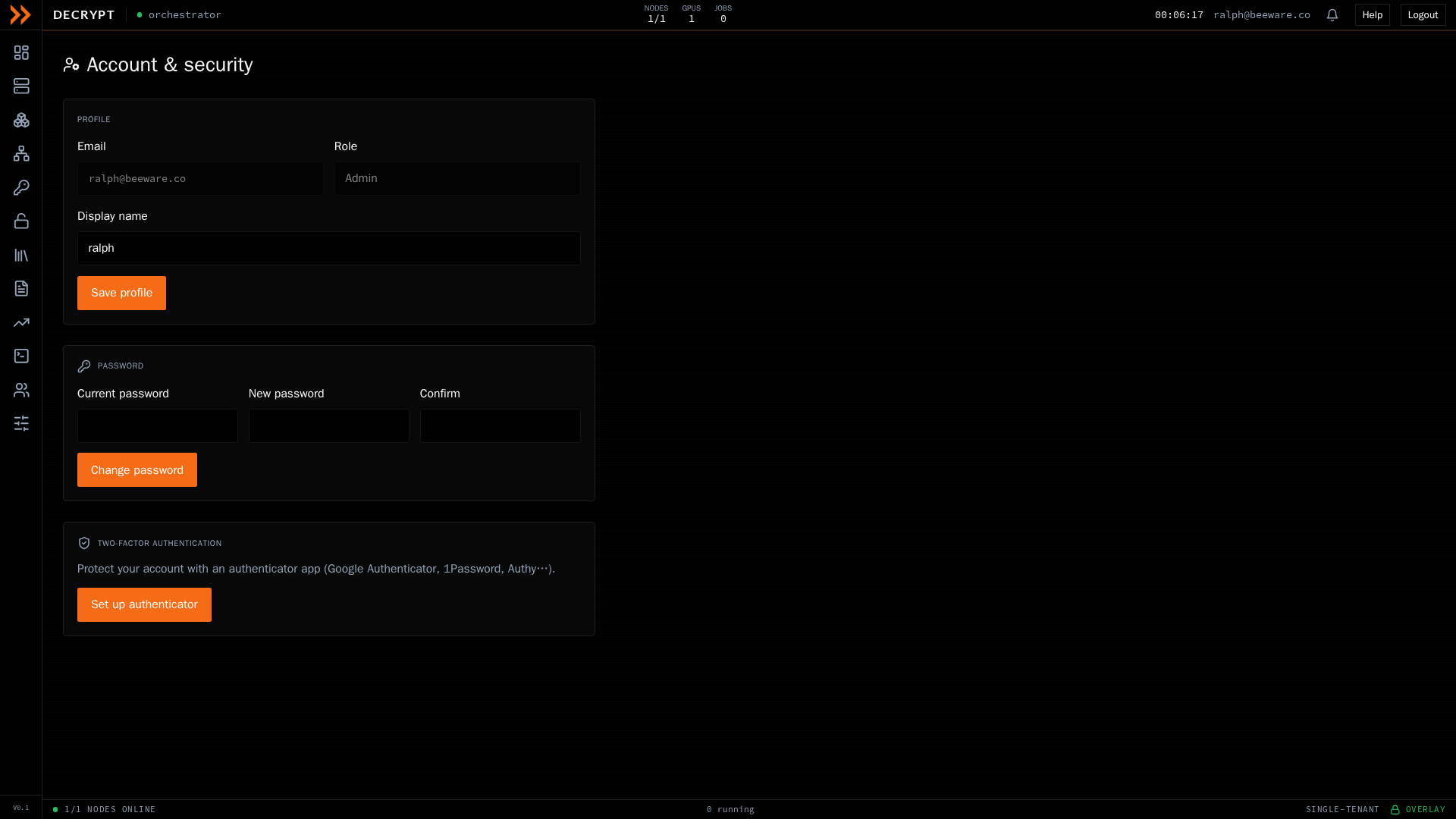
Manage your profile, password, and two-factor authentication
Manage your profile, password, and two-factor authentication
Profile
Section titled “Profile”Your email and role are shown for reference and are set by your administrator. You can change your Display name and click Save profile.
Password
Section titled “Password”To change your password, enter your current password, then your new password and a confirmation. Passwords must be at least 8 characters and the two entries must match. Click Change password to apply it. Changing your password ends every session, this one included, so you sign in again with the new password.
Two-factor authentication
Section titled “Two-factor authentication”Two-factor authentication protects your account with a one-time code from an authenticator app on top of your password.
To turn it on:
- Click Set up authenticator.
- Scan the QR code with an app such as Google Authenticator, 1Password, or Authy, or enter the secret key by hand.
- Enter the 6-digit code and click Verify & enable.
- Save the backup codes you are shown. Each works once if you lose your device, and they are not displayed again. Use Copy codes to grab them, then click Done.
If two-factor is already on, you can turn it off with Disable two-factor, unless your administrator requires it for your account, in which case the screen tells you it cannot be disabled.
API keys
Section titled “API keys”API keys let scripts and AI agents use the ARROW Decrypt API as you. A key holds only the permissions you give it, never more than you have and never rig terminal access, and it loses any permission you lose. The full API is described at /api/openapi.json.
To create a key:
- Click New key.
- Give the key a Name.
- Under Access, choose what the key may do (see below).
- Under Expires, pick 30, 90, 180, or 365 days, or Never expires.
- Click Create key.
- Click Copy key, store the key in a secret manager, then click Done. Send it as the
X-API-Keyheader.
| Access | What the key can do |
|---|---|
| Run crack jobs | Create engagements and jobs, ingest hashes, upload wordlists and rules, estimate, dispatch, stop, and read results and reports. It cannot approve jobs held at the gate, or change settings, users, or rigs. |
| Read only | Read jobs, engagements, results, reports, and the fleet. It changes nothing. |
| Choose permissions | Tick individual permissions, limited to the ones you hold. |
A preset that needs a permission you do not hold is not offered, and the form says which permission is missing.
Each key in the list shows its permissions, when it expires, and when and from where it was last used. Revoke stops a key on its next request.
Related documentation
Section titled “Related documentation”- Signing In - The sign-in and two-factor flow
- Team & Roles - What administrators manage for the whole team